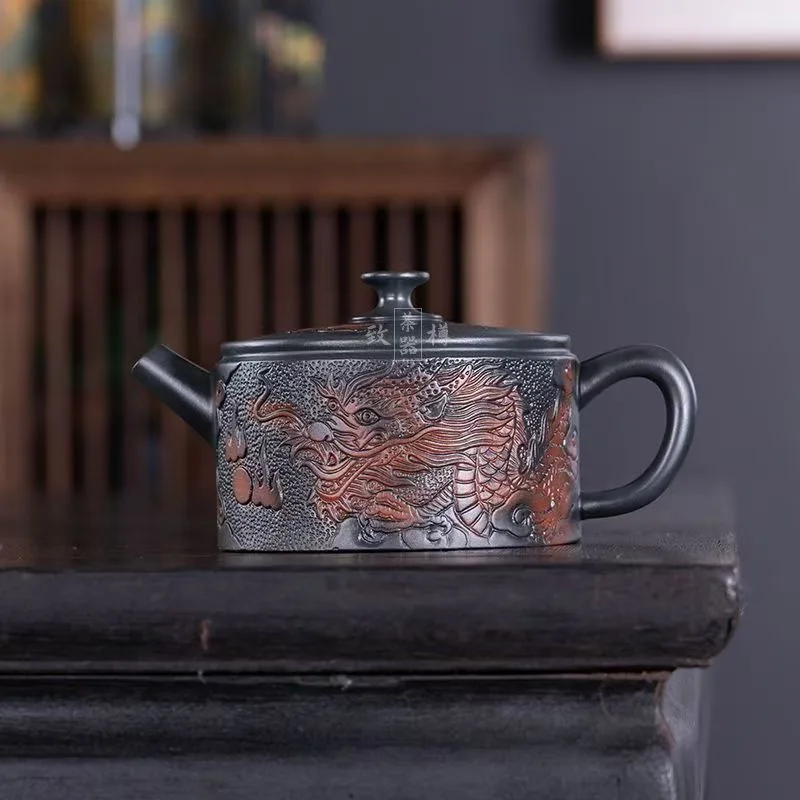
Yunnan Jianshui Zitao Carved Dragon Flat-Mouth Hanwa Teapot 200ml
SKU: NW-008
$89.17 – $265/ 把
Price varies by option
Select option
SKU: NW-008-V01
$89.17Carved dragon-phoenix flat-mouth Hanwa teapot, rotatable lid, whistling
1
Unit: 把- Sourced direct from Chaozhou
- Delivered in Vietnam
- 15-day returns
- Free replacement if broken in transit
Payment
CODMoMoZaloPayVisaMastercardBank transfer
✓ Direct from Source✓ Vietnam Delivery
Specifications
Clay and originYunnan Jianshui zitao clay, not Yixing zisha; the deep brown-black is the clay after firing
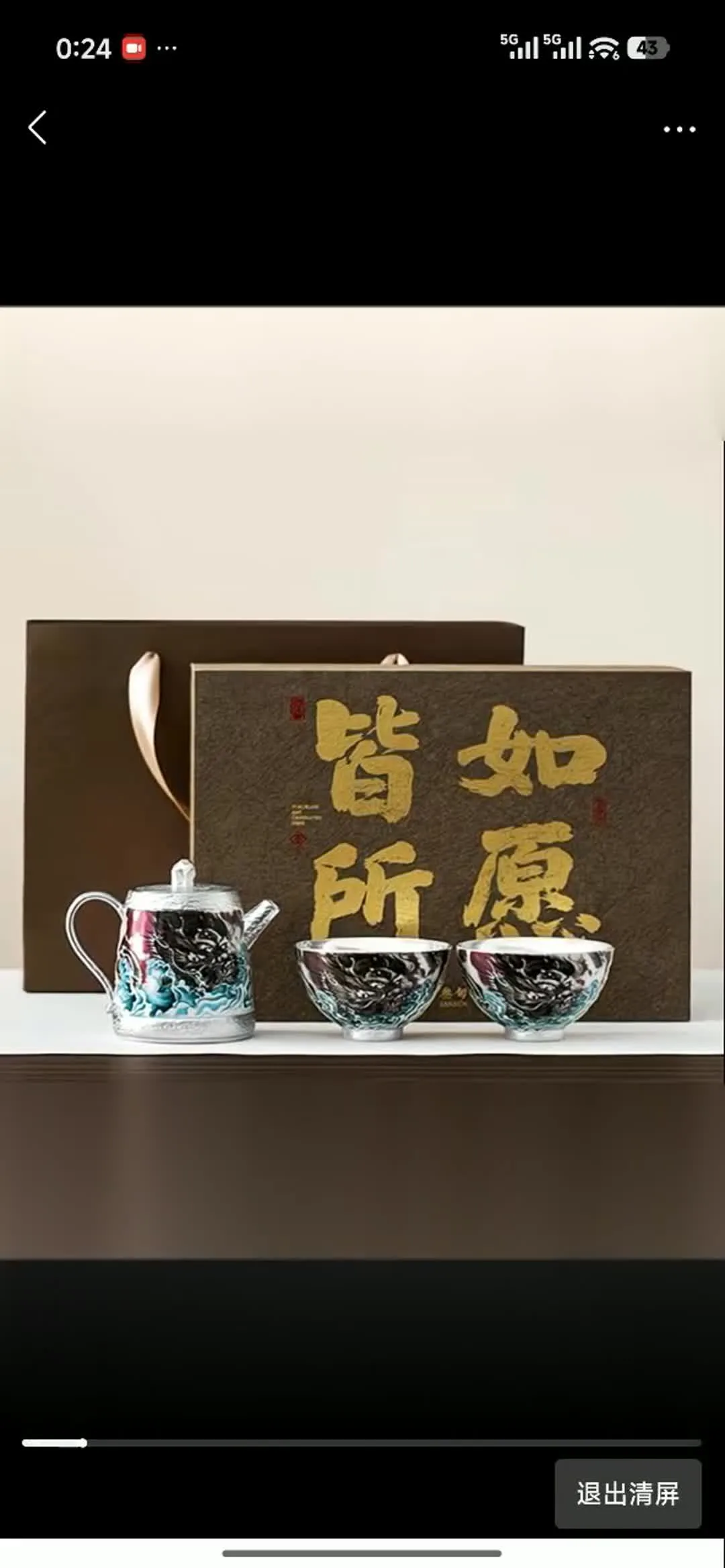
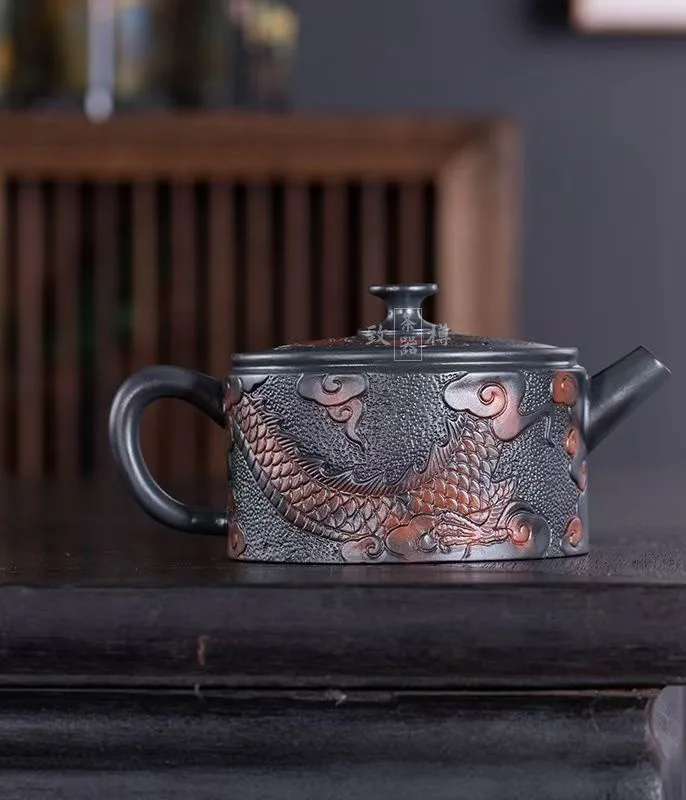
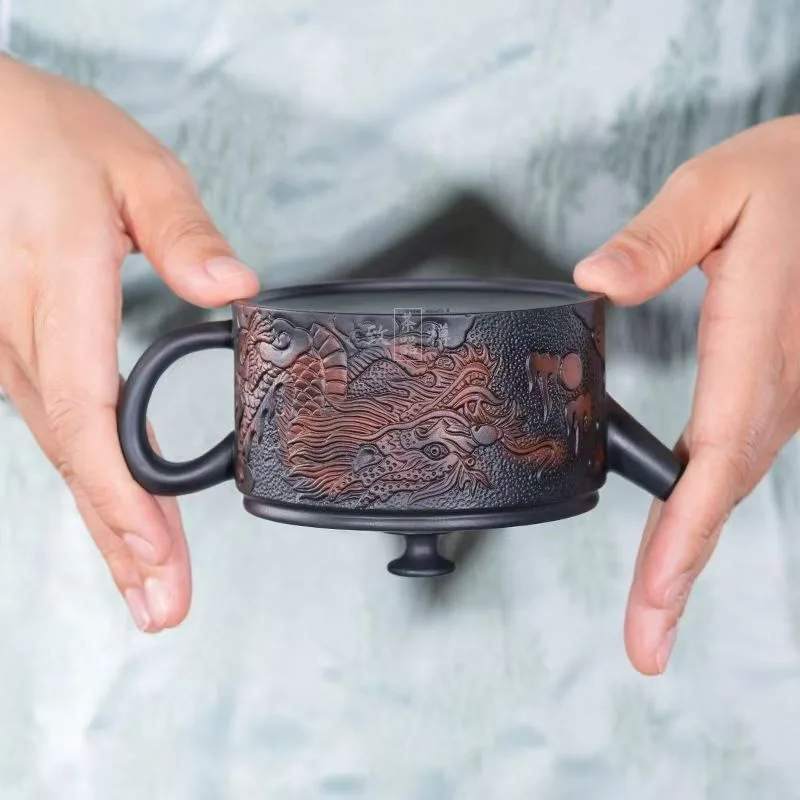
Body decorationHand-carved dragon and phoenix across the whole body, layered scales, red motifs on the dark ground
ShapeFlat-mouth Hanwa: low body, level rim, wide mouth, easy to load leaves and clean
CapacitySingle pot approx. 200ml (the set version is marked 250ml; capacity follows the version shipped)
Internal filterBuilt-in half-sphere mesh holes in the pot body; no separate strainer needed
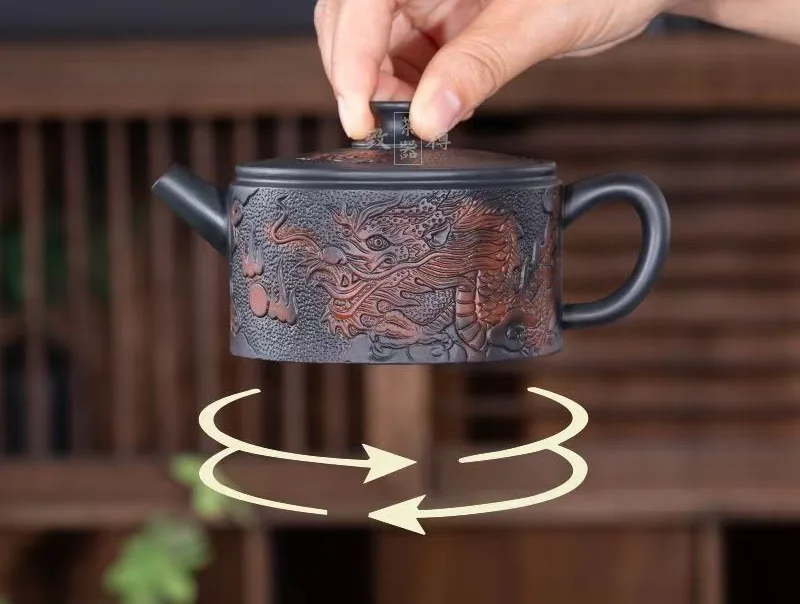
Knob and mouthOn an empty dry pot the knob lifts the whole body and turns freely; a fit check, not a way to use it
Phoenix noteA faint note may sound when pouring; it varies with water level and tilt, with no fixed promise
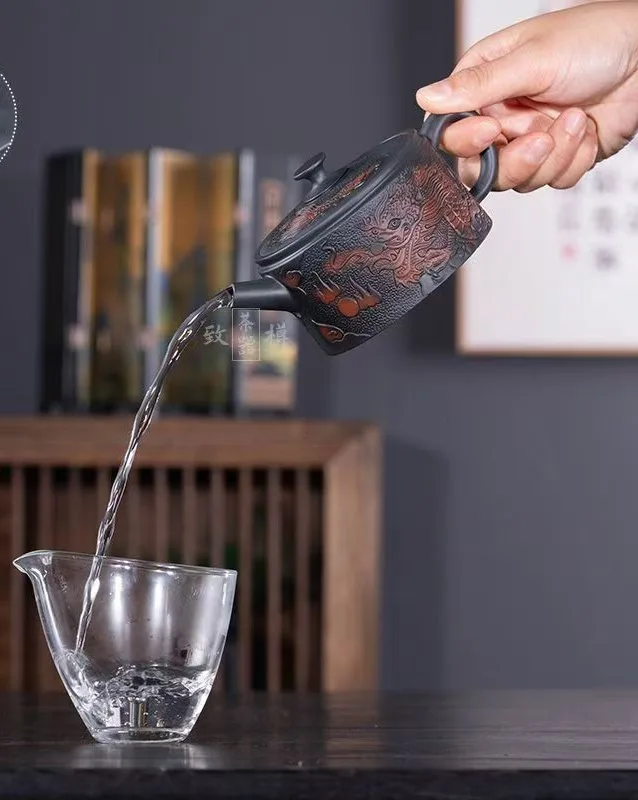
Pouring and cut-offA single continuous stream with a crisp cut-off; the video keeps the full pause
Measured sizeSingle pot approx. 200ml; card states diameter 15cm (described as width 15cm on the Vietnamese page), mouth 8.5cm, height 7cm; the cup-set version on the same order page is marked 250ml and capacity follows the version shipped
Product photos & details
Description
Shape and clay
This is a Yunnan zitao clay teapot, made in Jianshui. It is not Yixing zisha. The two differ in clay, in how the body is formed and in how the surface feels after firing, and this is exactly the point most easily glossed over when buying stock. Jianshui clay is fine; after firing the body turns a deep brown-black, with a warm matte finish rather than a hard gloss, and the colour does not come from a dark glaze laid over the surface. We stick to what can be seen: the colour comes from the clay and the fire, so daily boiling water has no layer to peel, fade or taint the tea. The pot does not take over the aroma, and weeks of use leave the tone much as it arrived. For drinkers who brew strong tea, that is more useful than a long story about where the clay was dug. When checking a shipment, take one photograph in daylight and one under the shop spotlights. A deep brown-black shifts in depth between those two lights, but the transition should stay even throughout and no patch should suddenly turn grey or white. We kept both angles in the gallery. Photograph those same two angles again when the pot arrives and any difference shows up immediately. The form is a flat-mouth Hanwa: a low body, a level rim and a wide opening. Set it beside a tall Xishi or Shipiao and the difference is obvious at a glance. Dry your hands before picking it up, so fingerprints do not sit on the very surface you are trying to examine.
Carved dragon and phoenix over the whole body, and how to tell it was cut by hand
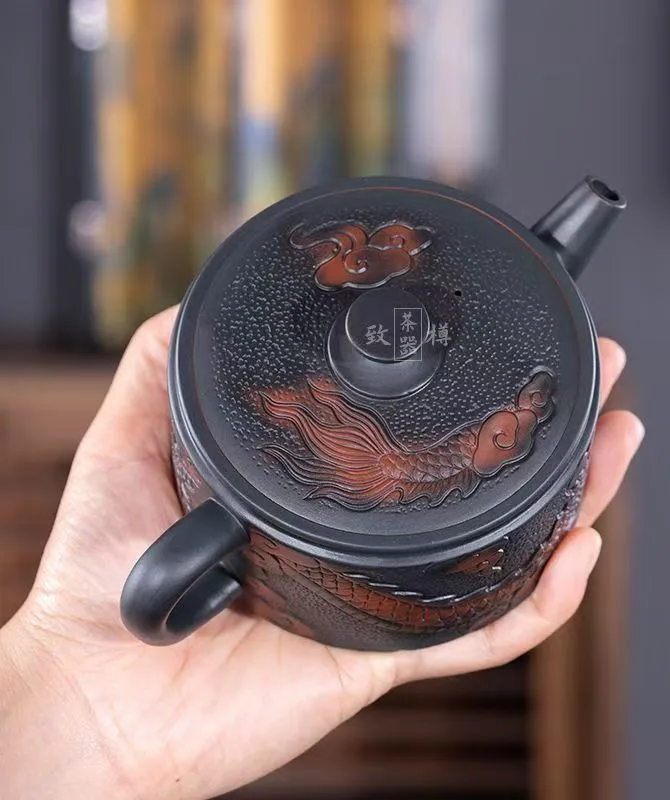
The most conspicuous feature is the raised carving that covers the body. Dragon and phoenix run across the whole surface, the scales are laid in overlapping rows, the phoenix feathers follow the curve of the body, and the red motifs stand out clearly against the dark ground. The marks of hand carving are not hard to recognise. Hold a lamp at an angle and the edges of the carved lines rise and fall slightly; the depth of the scales is not perfectly uniform; run a fingertip along the body and you feel each ridge lift under it. If the whole pattern was pressed from a mould, the depth is too even, the edges are round and blurred, and it feels more like a skin stuck on than a line cut into clay. We will not interpret carving schools on your behalf, and we do not call this a certificate or a grade. What we suggest is simple: film the body under raking light together with the lid face, then compare it with the in-stock clip we send. Slight variation between pots in one batch is normal, because hands and blades vary. But if a whole panel is blurred, if a corner of the pattern is missing a line, or if the red bleeds past the carved edge, that is no longer hand variation: set that pot aside and photograph it separately. For three close-ups — the dragon scales, the turn of the phoenix feathers and the motif on the lid — message Zalo: 0899286999. The full gallery and video are at www.tea14888.com.
The flat-mouth Hanwa shape: low body, wide mouth, easy to load leaves
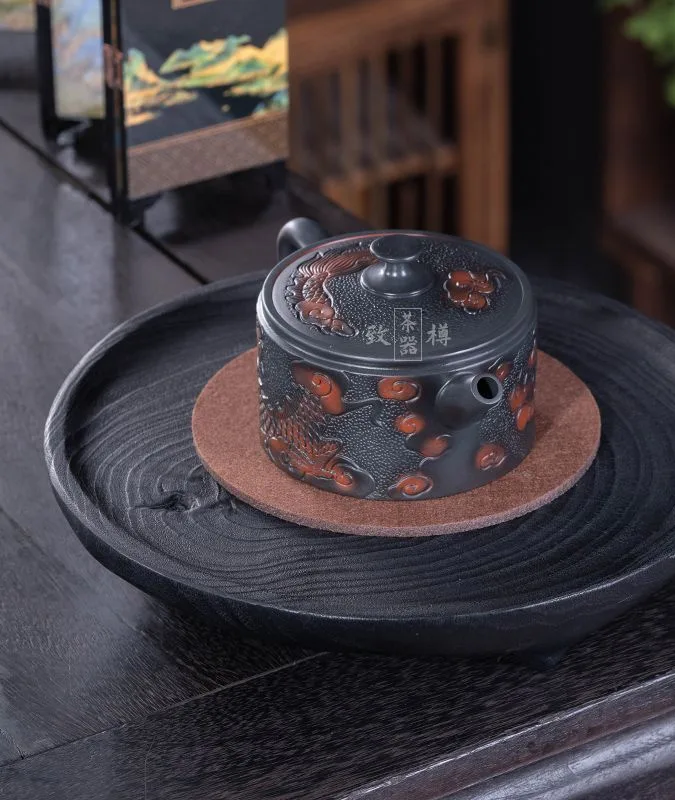
The advantage of the Hanwa form lies in the low body, the wide opening and the level rim. When loading leaves, your hand does not have to squeeze into a narrow mouth, so whole leaf strands are less likely to snap. After pouring, open the lid and light reaches the bottom of the interior directly; any leftover leaf is visible at once, one rinse with clean water clears it, and there is no corner your hand cannot reach. The body is 7cm high with an 8.5cm mouth, so it sits low and steady on the tray and is harder to knock over than a tall pot. For buyers taking volume, this shape also removes one problem: the end customer does not have to work out how to load leaves or how to wash the pot, and is less likely to make a mistake the first time. The gallery includes a full front view, the carving on the body, a hand holding the lid seen from above, the pot on its stand and several other angles. We do not use the shape to claim a rank or a value; we treat it as something that can be checked. Set the pot on a flat surface and look across it: the rim should form one straight line, and the body should taper evenly from mouth to foot, with no slumped shoulder or twisted mouth. That eye-level photograph belongs in the batch record too, because it shows at once whether a pot has come out of shape.
The built-in half-sphere filter holes
The filter on this pot sits on the pouring side inside the body, as a cluster of half-sphere holes, not as a separate strainer you have to buy. Open the lid and hold it to the light: you will see the holes packed close together in one patch, clear between one another, with none blocked solid. For wholesale buyers, the benefit is direct. There is one fewer part to wash, to keep in stock and to lose, and your customer does not have to work out how to fit anything before using the pot. Before dispatch we open every pot and look once, run a test pour of clean water, and film that step in a short clip. When inspecting a batch, take a few pots at random and check that the holes run continuously and are open, then pour clean water to watch the stream and the cut-off, and finally check the lid flange and the mouth for chips. Keep those inspection photographs on file. Shoot the same angles for every batch afterwards and comparing workmanship across batches becomes much easier. A half-sphere mesh is less likely than a single hole to be sealed by one leaf, but it is still not a good idea to tip fine leaf dust straight in. Day to day, rinse with clean water and leave it to dry; there is no need to poke the holes with a pin or scrub the mesh with a stiff brush. If residue builds up, soak in warm water for a few minutes and rinse gently.
The knob lifts the whole pot, the most unusual thing about it
The knob is not only for opening the lid. Pinch it and lift: the lid and mouth fit closely enough that the entire body comes up with it; turn it gently and the lid rotates smoothly inside the mouth, neither jamming nor loose. This is not a party trick. It is a direct check of fit. If the lid flange is loose, the pot will not lift; if it is too tight, it will not turn, or may bind altogether. On arrival, try it three times with the pot dry, holding it up for a second or two before setting it back down, and see whether it is steady each time. Do not do this with water in the pot, and do not do it with wet hands, which slip easily; this step is for an empty, dry pot only. We kept a close-up of the lift and the rotation in the video, including the wait for the lid to settle back, so you can compare frame by frame with your own sample. If a pot will not lift or turns stiffly, send us a video and let us check it before you sign anything off. This action also explains why the mouth is made flat: a flat mouth with a flat lid is what allows both lifting and turning. It is the detail customers are most curious about when they first pick the pot up, which is why we usually leave it until last when presenting it in a shop.
The phoenix note when the pot is tilted
Tilt the pot to pour and it gives a small, fine note; potters call it the phoenix call. It comes from how the lid, the mouth and the air path inside the body work together, so the amount of water, the angle of the tilt and how firmly you press the knob all change it slightly. It will not sound identical every time, and it should not be pinned to a fixed pitch. We kept the sound together with the pouring shot in the finished video, and did not lay music or an effect over it. One thing should be said plainly: the phoenix note is an interesting detail, but it is not the only measure of the whole pot, and it is certainly not a certificate or a grade. What still has to be checked item by item is the fit of the lid flange, the mesh inside the body, the depth of the carving, whether the pour forms a single line and whether the cut-off is crisp. If you do not hear it the first time, change the tilt, reduce the water to about seven tenths full and try again; if there is still nothing, send us a video. We make no promise about the sound. We simply record it as a phenomenon that can be reproduced with the batch. Whether you hear it or not, do not conclude the pot is faulty; go on through the rest of the checklist.
Measurements and how we write them down
Capacity is approx. 200ml. The specification card packed with the batch also states diameter 15cm, mouth 8.5cm and height 7cm. Because Vietnamese buyers plan shelf space by width and estimate how many pots fit in a carton, the Vietnamese page describes the 15cm figure as the maximum width, while the Chinese and English pages keep the card's original word, diameter. The numbers are unchanged: no rounding, and no borrowing figures from another pot. One conflict has to be spelled out: on the same order page, the single-pot version is marked 200ml while the one-pot-two-cups version is marked 250ml. The version we present and mainly sell is the single pot at 200ml, so every capacity on the page follows that version. If you later choose the set with cups, the capacity follows the version actually shipped, and you can ask for a water-fill measurement before confirming. Anything the card does not state we leave blank; we do not estimate and do not add. For a photograph with a ruler placed against the exact pot that will ship, message Zalo: 0899286999 — we put the ruler beside that pot and shoot it on the spot, with no stock imagery. Writing one wrong number causes more trouble than leaving one out, so we would rather add a sentence of explanation than keep it short. These four figures are also what customers ask about first, so they are worth putting at the top of any reply.
Pouring and cut-off
Fill the pot, seat the lid, press the knob and tilt forward: the water gathers at the spout and falls as one line, continuous and without spray. Stop your hand and the stream cuts cleanly, with nothing running back down the body and no drips onto the tray. One pour of clean water is enough to check it — does the stream hold a single line, does it stop decisively, is there a wet mark left on the table. The video keeps this close-up intact, including the pause while the water cuts off. We do not write the output as an exact number, because water temperature, leaf volume and tilt all change it; what can be verified is the shape of the stream and the cut-off action, and both are clear in the video. A low, wide-mouthed pot has a lower centre of gravity, so tilting feels different from a tall pot; on the first try use clean water at about seven tenths full rather than filling it with boiling water straight away. If a pot splits the stream, clings with water or trails at the cut-off, first check that the knob is pressed firmly and that no leaf is blocking the inside of the spout, then send us a video to compare. Do not sign off in a hurry. One test pour takes under ten seconds and answers quite a few questions about the fit and finish of the mouth.
Lid flange, knob and mouth
The knob is shaped to be pinched and lifted with one hand, so opening for leaves and closing to pour is one continuous sequence with no change of grip. The flange and the mouth fit at exactly the point where the whole pot can be lifted and the lid can still be turned: seat the lid and it does not wobble, yet it is not so tight that you cannot lift it off. On arrival, run three dry checks first — close the lid on an empty pot, pinch the knob and lift the whole body, rotate half a turn and set it back — and if all three run smoothly, this part is sound. A flat mouth has one practical advantage: the entire contact face of the flange is visible as soon as you open the lid, so you can see any chip or grain of grit caught there; wiping the rim each time you wash saves tracing a fault later. If the flange has a small chip, photograph it for the record and set that pot aside rather than letting it into the batch waiting to ship. We do not promise zero tolerance or any precision grade. We simply describe an action both sides can repeat, so you and your customer check the same part in the same way. It also gives both sides a shared vocabulary, with no guessing about which component the other means.
The brown-black body, the red carving and what colour variation means
A deep brown-black body with red raised carving is what makes this pot recognisable, and it is also the easiest thing to misread. The brown-black shifts noticeably in depth under different light; red looks brighter under warm shop lamps and deeper in daylight. That is normal. We suggest keeping two fixed reference angles: one full-pot photograph in daylight and one at the same angle under the shop spotlights, both filed with that batch. Slight differences in depth within one batch are normal, the result of clay, kiln fire, blade and hand pressure. But if the whole body turns grey, if there is a white patch, if red bleeds outside the carved edge, or if one area splits into two distinct tones, that is no longer colour variation: separate the pot, photograph it clearly and send it over. We do not define a standard colour on your behalf, and we do not take one reference photograph and demand every pot match it exactly. We offer a way of shooting and comparing that both sides can actually follow. For those two reference angles as original files, message Zalo: 0899286999. Do not compare colour from a screenshot or a compressed chat image — compression shifts dark tones quite a lot; ask for the originals and compare them on the same screen.
Inspection checklist on arrival
Work in this order; each pot takes under two minutes. One, set it on a flat surface and look across it to see whether the rim forms one straight line and whether the shoulder slumps or the mouth twists. Two, open the lid and hold it to the light to see whether the half-sphere mesh runs continuously and is open, with no blocked holes. Three, run three dry checks: close the lid, pinch the knob and lift the whole body, rotate half a turn and set it back, and confirm it is steady each time. Four, look at the carving under raking light — are the scales layered, do the feathers stand proud, has the red bled past the carved edge. Five, fill about seven tenths with clean water and pour once, checking whether the stream holds a line, whether it stops cleanly and whether the table is left dry. Six, match the four figures on the specification card against the product page, with capacity taken from the single-pot 200ml version. Seven, take one photograph in daylight and one under the shop lamps for the record. If any step is wrong, set that pot aside, take a clear close-up and send it over. There is no need to return the whole batch, and no need to sign for it before talking to us. Your own resellers can use this same checklist, so it is worth sending them a copy; it saves a great deal of back-and-forth explanation. Printed and stuck next to the unpacking table is the most practical form — anyone can follow it without separate training.
Common questions
Is this Yixing zisha? No. It is Yunnan zitao clay made in Jianshui; the clay and the forming method are different, and the page names it accordingly. Can the knob really lift the whole pot? Yes, when the pot is dry and empty; once it holds water, do not lift it that way — this is a fit test, not a way to use the pot. Does the phoenix note sound every time? Water level, tilt and knob pressure all change it; we describe it as a reproducible phenomenon and make no promise about it. Is the capacity 200ml or 250ml? The single pot is 200ml, which is the version we present and mainly sell; the one-pot-two-cups version on the same order page is marked 250ml, so capacity follows the version shipped, and you can ask for a water-fill measurement first. Will the red carving fade? The colour comes from the clay and the post-firing treatment, not a layer that can be scraped off; rinse with clean water and dry upside down, and avoid abrasives or oils. Can I see real stock before committing to a full batch? Yes — see the section below. Does the pot come with cups or a stand? The version presented here is the single pot; versions with cups or a stand are selected separately on the page, so tell us which one you want before confirming.
Everyday cleaning and care
After use, while the pot is still warm, tip out the leaves, rinse the interior and the half-sphere mesh once with clean water, run a finger around the rim, then leave it upside down to dry fully before closing the lid. No detergent is needed, and there is no need to soak it in tea to season it; this surface does not need deliberate seasoning, and the tone will naturally settle a little with use, which is a normal change. The recesses between the red carved lines tend to hold fine leaf, so a soft brush passed lightly along the lines is enough — do not use metal scourers, abrasives or a hard pin on the mesh. Do not close the lid tightly while it is still wet; let it air first, to avoid a musty smell. When displaying or handling stock, avoid wiping the same spot over and over, because that spot will turn unusually glossy and is easily mistaken for colour variation in a photograph. If it will be stored for a long period, dry it and keep it on an airy shelf, not sealed in a plastic bag. None of this is complicated, but writing it down prevents a fair number of mistakes by your customers, especially those handling Yunnan clay pottery for the first time. The full gallery and video are at www.tea14888.com; for a sample cleaning clip, message Zalo: 0899286999.
Using 200ml to taste tea
200ml is a very workable size for tasting. Put in one lot of tea, fill it, and pour into a few small cups so everyone at the table gets a sip, without brewing a large pot that nobody finishes. For buyers who compare tea lots before ordering, the method is simpler still: use the same pot, the same leaf weight, the same water temperature and the same steeping time, changing only the tea sample; then photograph the liquor colour and the wet leaf from three lots and file them together. A wide mouth and an interior with no blind corners mean one rinse clears it between samples, so flavours do not carry over easily. A low body sheds heat a little faster than a tall one, so in cold weather warm the pot with hot water first to keep conditions closer between rounds. We do not call this capacity a standard of any kind. We simply offer a method that can be followed: Vietnamese drinkers usually brew the whole pot and then divide it into cups, and 200ml sits right within what one round can finish. If the table is larger, two rounds are still tidier than switching to a big pot from the start.
Display and how to present it in a shop
For display, set the pot on a neutral-coloured stand with one small teacup beside it as a size reference; that helps customers judge dimensions far better than showing the pot alone. Do not aim the lamp straight at the surface — an angled light is what brings out the layers of dragon scales. When presenting, take measurements first, carving second and the knob test last. Measurements are the easiest to verify and the most frequently asked about, so clearing them up at the start removes half the later questions. For the carving, use raking light and invite the customer to run a hand over it themselves. Leave the lift-and-rotate until the end, because that is the action customers remember longest. If a customer asks about price or ordering, direct them to Zalo: 0899286999 or www.tea14888.com; we reply against the batch actually in stock rather than giving a vague figure at the counter. This order does not depend on polished sales talk, so a new shop assistant can follow it and still explain the pot clearly without memorising a script.
Packing and delivery checks
When the shipment arrives, count the cartons first, then open each box and check three things: whether the rim is chipped, whether the lid flange is intact, and whether the red carving has been rubbed into a glossy patch. As you open a carton, take one frame that includes the outer box, the inner padding and one pot together and keep it; if there is transport damage, that photograph is worth far more than a description written afterwards. Once checked, go through the checklist above pot by pot and keep the accepted group separate from the group needing review, rather than putting them back into the same carton. The gallery and video are at www.tea14888.com; packing and accessories follow the version actually shipped, and you can ask for pre-dispatch carton photographs in advance. We do not promise a fixed packing grade. We spell out what to look at and which photograph to keep, so both sides talk from the same set of evidence. If a pot needs exchanging, include the batch code and the exact photograph taken when the carton was opened — that makes the process considerably faster.
How this differs from Yixing zisha, and what to look at twice
This is Yunnan zitao clay made in Jianshui, not Yixing zisha; clay, colour and surface feel are all different. Jianshui ware comes out a deep brown-black with a warm matte finish, while Yixing zisha is usually orange-red or purple-brown with a distinctly sandy feel. If your customers are used to inspecting Yixing ware, two misreadings are common: a surface without visible sand grains gets taken for poor work, and the red dragon-and-phoenix carving gets taken for paint applied afterwards. So on inspection, take one extra look: under raking light, does the carving stand proud of the body, do the edges rise and fall; then run a hand along the body once. Only when a whole panel is blurred and rounded, like a layer stuck on, should that pot be set aside. We do not rank one clay above the other and we do not draw conclusions on a customer's behalf. We simply set out the checkable differences, so the wrong acceptance standard is not applied in the first place. Using the right standard from the start saves a lot of explaining later, especially with customers who have sold zisha for years.
Filming an inspection clip both sides can compare
A usable inspection clip does not need editing. Hold the phone horizontally and shoot one continuous take in this order: set the pot on a flat surface and rotate it half a turn to show the rim and body; open the lid and hold it to the light for two seconds so the half-sphere mesh is clear; close the lid on the empty pot, pinch the knob and lift the whole body, rotate half a turn and set it back; move in slowly under raking light to reveal the dragon scales and phoenix feathers; fill about seven tenths with clean water and pour once to show the stream and the cut-off; finally place a ruler beside the pot and take one still photograph. Keep one lamp and one angle throughout, and do not change the light source midway. Send the clip to us first; we take a pot from that same batch and film it back in the same order, and once the two can be compared frame by frame we talk about quantity. If one frame does not match, cut out that frame and say what is wrong — there is no need to reshoot the whole clip. Your own customers can use the same method. It removes a great deal of back-and-forth explanation and turns the question of whether this batch matches the last one into something with evidence you can look at. Sample photographs and clips are at www.tea14888.com; message Zalo: 0899286999 if you need the reference clip.
Check one pot first, then discuss the whole batch
On a first order, check just one pot first. We take one from the batch being dispatched and photograph it against the checklist above — the ruler measurement, the mesh, the lift and rotation, the carving under raking light, the stream and the cut-off — and send those to you before anything else. Once you confirm that this set of angles and this way of recording measurements work for you, we discuss quantity. That is far less trouble than shipping a whole batch and then arguing pot by pot. After that is agreed, we file the same set of angles for every batch, which makes comparing workmanship across batches much easier. Tell us which photographs and which clips you need and we shoot exactly those, with no stock imagery and no old batch photographs spliced in. Message Zalo: 0899286999 and say which part you want to see; the full gallery, three-language details and finished video are at www.tea14888.com. We make no claims about certificates or grades, and we do not predict future prices. We hand over, one by one, only the things that can be photographed, measured and repeated, for you to check yourself.
Documents you can ask for
Everything below is available, shot from the batch actually in stock, with no stock imagery: one, a ruler photograph with the pot, capacity taken from the single-pot 200ml version; two, close-ups of the half-sphere mesh and the lid flange; three, three raking-light frames of the dragon scales, the turn of the phoenix feathers and the motif on the lid; four, a slow-motion clip of the lift and rotation plus the pour and cut-off; five, two full-pot frames at the same angle, one in daylight and one under shop lamps, for comparing colour across batches; six, carton photographs taken before dispatch; seven, the full inspection clip shot in the order described above. Message Zalo: 0899286999 with the items you need listed clearly. The complete gallery, three-language details and finished video are at www.tea14888.com. We promise no certificate, no grade, and we do not speculate on what it may be worth later. We deliver only what can be photographed, measured and done again, for you to verify. This approach is slower than a short advertising line, but for a buyer importing stock to resell, it is what decides whether they dare to ask for a price at all.